

How to Produce a Good Golf Swing?
Unfortunately, the golf swing is thought as a complicated and unnatural movement. It is actually a simple movement like many other everyday motions.
The golf swing starts with a balanced stance and a relaxed grip. You will move into a backswing by rotating your body while shifting your weight to your backfoot. Then, rotate your body and shift your weight forward for the downswing. Make contact with the ball and finish with a full follow-through
1) Backswing
Swing the clubhead back with the hands (both hands!) toward the right shoulder so that the club is over the shoulder at the end of the backswing. The hands must be used so that a coil is created to generate the desired swing speed. The hands are used to swing the clubhead to the end of the backswing, where the arms take over and swing the club to the end of the swing.
Clubhead and shoulders start to move together, stay together and reach the end of backswing together.
Both hands are used in the backswing and both arms are used in the forward swing. Use both hands to make a good backswing.
Some golfers reduce the use of the low hand in the backswing and make the high hand dominant during the backswing. A dominant high hand during the backswing causes the club to be laid off with the shaft pointing much to the right of the target and the clubhead facing the sky.
2) Forward Swing
At the end of the backswing, the responsibility for the forward swing shifts to the upper arms, i.e. the extremity from the shoulders to the elbow. The upper arms swing the club to the end of the (forward) swing in one uninterrupted motion. Through their speed, the arms are responsible to maintain the coil action that was produced by the hands during the backswing. This coil enables the golfer to generate swing speed. The greater the arm speed, the longer the coil will be retained.
A player has reached the limit of his distance when the arm speed cannot be increased. When the hands are used in the forward swing, the coil is destroyed. The arms will slow down and reduce the swing speed. If the hands or forearms are used in the forward swing, this will cause a casting.
3) Hand Action during Forward Swing
Try to increase distance by focusing on increased speedness of your upper arms.
Golfers try to increase speedness in the last moment by using their hands during the forward swing to hit the golf ball stronger. In reality, hand action in the forward swing is causing over 90% of all missed shots.
Using the hands shortly before ball impact is borne by the desire to control the ball flight and to increase power for more distance. Everybody has a tendency to help, but the swing will never accept this help
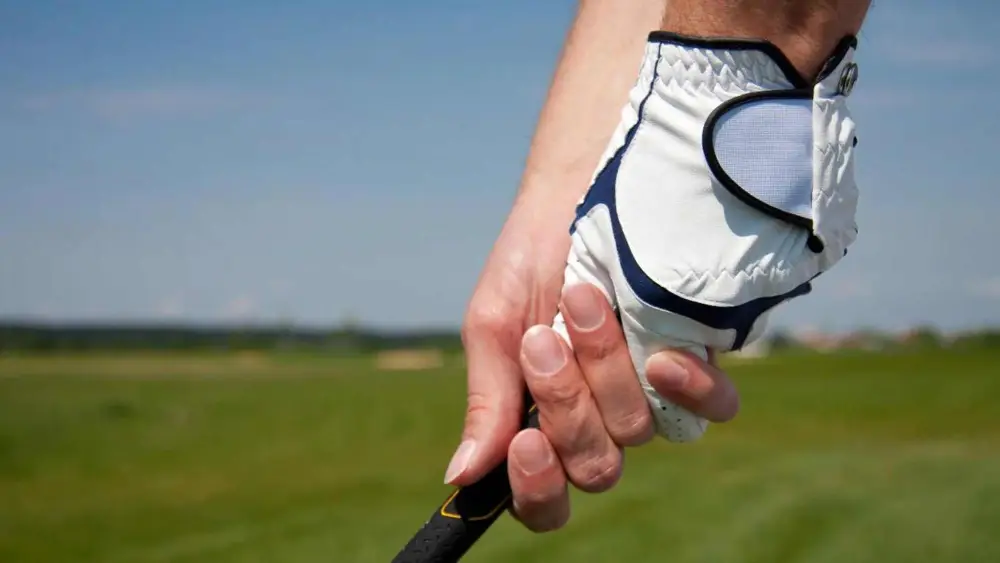
Drill: A good way to enhance the hand’s passiveness is to maintain the grip pressure, do not increase the grip pressure anywhere in the forward swing.
If the hands are so detrimental for the forward swing, what is their function anyway?
- Hands are used to hold the club
- Hands passively transit to the club the motion produced by the arms
4) Error: A Pause at the End of the Backswing?
A player should make no intentional effort to stop or pause at the end of the backswing.
if a player consciously pauses at the end of the backswing, the mental and physical purposes will get lost. A pause will destroy the continuity between the backswing and forward swing. The swing should never be split.
A deliberate pause at the end of the backswing will cause a tendency to slice the shot because the forward motion will be started with the shoulders. The ball will start to the left of the target and spin to the right (for right hand players).
5) Role of Back Foot at Forward Swing?
For right-handed players the back foot is the right foot.
The back foot is the key to keep the body and the club’s motion synchronized. it is a responsive movement.
What happens to the swing when the back foot does not respond? The biggest error is that the shoulders are used to swing the club in the forward swing. This makes the club approach the ball with an outside to in pattern, causing often pulled slices.
6) Should the Weight be Shifted to the Back Foot in the Backswing?
A common theory is saying that the weight should be shifted to the back foot in the backswing.
The golf club is describing a circle when it is swung. Being a circle, it must have a center. If this center moves to a different location, it is impossible to return to the starting point. When the center is allowed to move to the right through a weight shift in the back foot, this center must be re-established before the ball contact, otherwise a square impact is not possible.
if the same center is kept, the club can be returned to the exact address position at the end of the backswing. The club will be square to the target line without the need to change the club position. The same center makes things easier.
7) Flexibility and Speed
For golf, tension and body stiffness are the player’s biggest enemy. Whereas flexibility is the player’s greatest friend.
8) The Follow-Through or the End of the Swing
It is not produced by the player, it is the result of the velocity with which the golf club has been swung. It is simply a result of producing the swing.
- Full rotation: Continue the rotation of your body through the swing, allowing your arms to extend toward the target
- Finish: Finish in a balanced position, with your weight fully on your front foot and your chest pointing toward the target
- Relaxed finish: Your arms should finish in a relaxed position, with the club high and away from your body
9) Summary: What is a Good Swing?
Swing the clubhead with your hands in the backswing so that your club ends over your shoulders.
Then, swing the club with your upper (!) arms in one uninterrupted motion to the desired target.
Allow your body to automatically respond to the swing.





Comments are closed.